
Picture this. It’s 10 a.m. on a peaceful Sunday morning. The coffee maker is bubbling, birds outside are chirping, and all seems right in the world. After some major procrastination and light doom scrolling, you finally drag yourself out of bed and make your way to the kitchen to start your day. Rubbing the last bit of sleep from your eyes, you open the fridge and see the carton of eggs you picked up at the market yesterday. Perfect. That’s just what you need — a couple of perfectly cooked fried eggs. But what’s the best method to make them? Basted with butter? Cooked in pesto? Low and slow? The possibilities feel endless. However, you remember reading about a guy who fried 30 eggs in 30 days and can probably weigh in here.
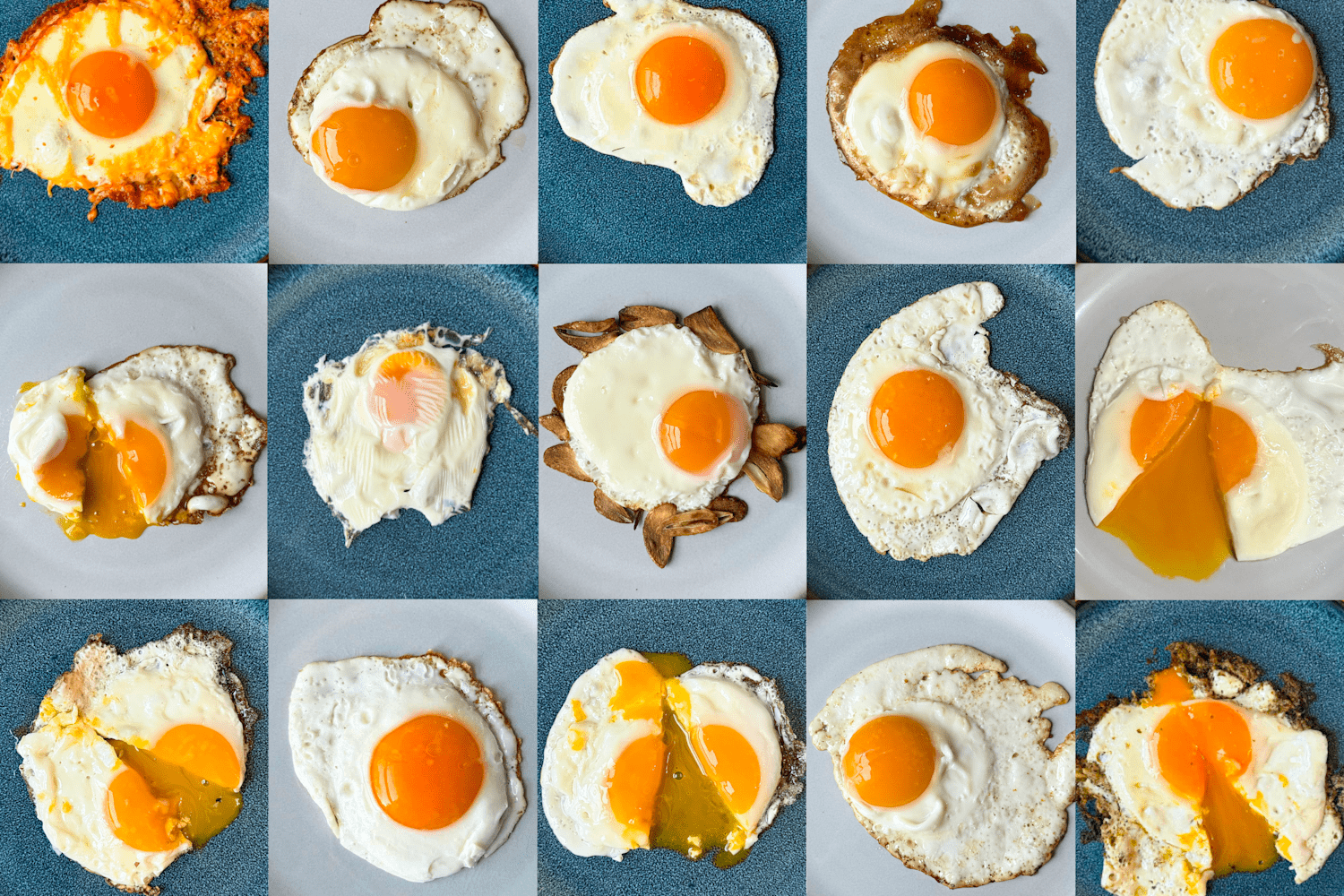
Well, it’s true. I’m that guy. I recently (and heroically) set out on a journey to fry an egg every single day of the month to determine what separated a good fried egg from a great one. While we have delved in the past into which is the best overall method for making a standard fried egg, I wanted to think further outside the box.
To me, a fried egg is the epitome of a quintessential breakfast. The jiggly, golden yolk, gently sitting in a blanket of flawlessly set whites with a slight crisp around the edges; it’s the kind of thing that makes me believe in magic. However, I, too, have felt the overwhelming pressure of not knowing which method to use to cook the perfect fried egg. That’s why I’m proud to say, dear friends, that after this month I think I’ve cracked it (pun intended).
A Few Notes on Methodology
The ingredients. To give each method a chance, I wanted to stay as consistent with my ingredients as possible. Every egg used was a Vital Farms Pasture-Raised Large Egg that had been purchased no longer than a week before cooking. This ensured the freshest quality of egg for each method, which meant tighter whites, bouncier yolks, and altogether better taste. All eggs were seasoned with a pinch of salt in the pan, making sure to get coverage over both the whites and the yolks. Lastly, every test was performed with a singular egg per method
The testing. To determine what methods I would be testing, I pulled from a combination of my previous experience frying eggs, previously tested methods on the site, and my overall culinary knowledge. The first 15 tests centered around determining which fat would be the best partner in crime for frying the egg. For these tests I cooked each egg in a small nonstick skillet that had been preheated over medium heat for 2 minutes. I then added 1 tablespoon of fat to the pan, which I allowed to heat for 30 additional seconds before adding one large egg to the skillet.
Once a winning fat had been decided, the following eight tests used that fat to determine the ideal cookware (nonstick skillet, cast iron, stainless steel, etc.) and technique (cooking over low heat vs. high heat, covering the pan, etc.) needed to produce the most delicious fried eggs. All cookware was preheated for the same length of time and set over medium heat unless the testing required otherwise. Lastly, the final seven tests involved following popular recipes online, using the winning fat, cookware, and technique unless specified otherwise.
The scoring. What constitutes a great fried egg is by no means a universally agreed upon concept. However, I’m fairly confident in what I like in a fried egg. First off, I want some browning on my white. Not so much that the entire bottom of the egg tastes like rubber, but enough for a bit of textural contrast. Bonus points for crispy edges, minus points for tough, plasticky edges you sometimes get around the edges of the white.
Second, I want my yolk smooth, shiny, and runny, and I mean RUNNY. Points were taken off if any fat sputtered on top of the yolk and ruined the perfectly even facade, or if the yolk overcooked by the time all the whites were set. Which brings me to my final point in scoring: fully set whites. It’s not the quality I’m proudest of, but undercooked egg whites do occasionally give me the queasies. Therefore, all whites had to be fully set. Once all methods had been completed, I chose my 5 favorite methods, all of which should result in a delicious fried egg.
The Best Fat for Texture: Vegetable Oil
About this method: After preheating a nonstick skillet over medium heat for 2 minutes, I added 1 tablespoon of vegetable oil to the pan and heated for 30 seconds before the egg was added.
Results: Sometimes, the classics really come through and show you why they still reign supreme. This egg was the blue ribbon for me. Crispy browned edges, a soft, creamy yolk, and a distinction of textures from the bubbling of the whites once the egg hit the oil. The high smoke point of the oil meant no burnt taste, but instead left a faint french fry flavor that was absolutely addicting. And all done in two and a half minutes. Just watch out for some sputtering oil in the beginning, and you’ll be left with the perfect fried egg.
The Best Fat for Flavor: Oil + Butter
About this method: After preheating a nonstick skillet over medium heat for 2 minutes, I added 1/2 tablespoon of vegetable oil and 1/2 tablespoon of butter to the pan and heated for 30 seconds before the egg was added.
Results: If you’re willing to trade a little bit of crispiness for a bit more flavor from your fat, a combo of veg oil and butter is the way to go. While the extra water content in the butter means less browning of the whites, the creamy flavor it adds is well worth it in my book. The milk solids in the butter fry in the oil along with the egg, adding a toasty, caramelized flavor that is absolutely remarkable. Think white cheddar mac & cheese, buttery mashed potatoes, and a slight hint of crème brûlée. While yes, this method takes a bit longer than straight-up vegetable oil (3 minutes versus 2 minutes and 30 seconds), it’s well worth the extra 30 seconds.
The Biggest Surprise: Beef Tallow
About this method: After preheating a nonstick skillet over medium heat for 2 minutes, I added 1 tablespoon of beef tallow to the pan and heated for 30 seconds before the egg was added.
Results: Well tallow, gorgeous (sorry, had to)! Who would have thought a little rendered beef fat would produce such a delicious fried egg! I’ll admit, I was wary at first, as I was fairly sure the gamey smell of the tallow would translate to completely overwhelming the delicate flavor of the egg. However, what I thought would be a musky, pungent disaster, tasted surprisingly like a fast-food chicken nugget. Additionally, the tallow added a nice level of salt to the egg and beautifully browned the whites. Yes, tallow can be a bit pricey, but if you have some on hand, fry an egg in it!
The Speedy Method: Basted
About this method: After preheating a nonstick skillet over medium heat for 2 minutes, I added 1 tablespoon of vegetable to the pan and heated for 30 seconds before the egg was added. After adding the egg, I basted the whites with the hot oil until set.
Results: For those of us that want to feel a little cheffy in the morning, this is a great option. Instead of standing by and watching the egg cook, you gently spoon the hot oil on top of the egg whites to encourage them to cook faster. By doing this, the egg cooks in a speedy 1 minute and 30 seconds from both the top and bottom, rather than just from underneath. This is a great option for those who like a little bit of browning on their whites, but not too much, as the shorter cook time means the edges still get nice and crisp, but the bottom stays nice and velvety smooth.
About this method: After preheating a wok medium heat for 2 minutes, I added 1 tablespoon of vegetable oil to the pan and heated for 30 seconds before the egg was added..
Results: If you’re fairly coolheaded and not afraid of a little jumping oil, please fry an egg in a wok. Trust me when I say the textures this method produces are truly unique and absolutely addicting. Because of the sloped shape of the wok, all the oil collects at the bottom, creating a little pool of hot fat for the egg to chill and gently fry in. The result is a tightly packaged egg with large fluffy air pockets and an insanely crisp bottom, all in 2 minutes flat. And remember that french fry flavor from above? Yeah, that’s here, too.
