

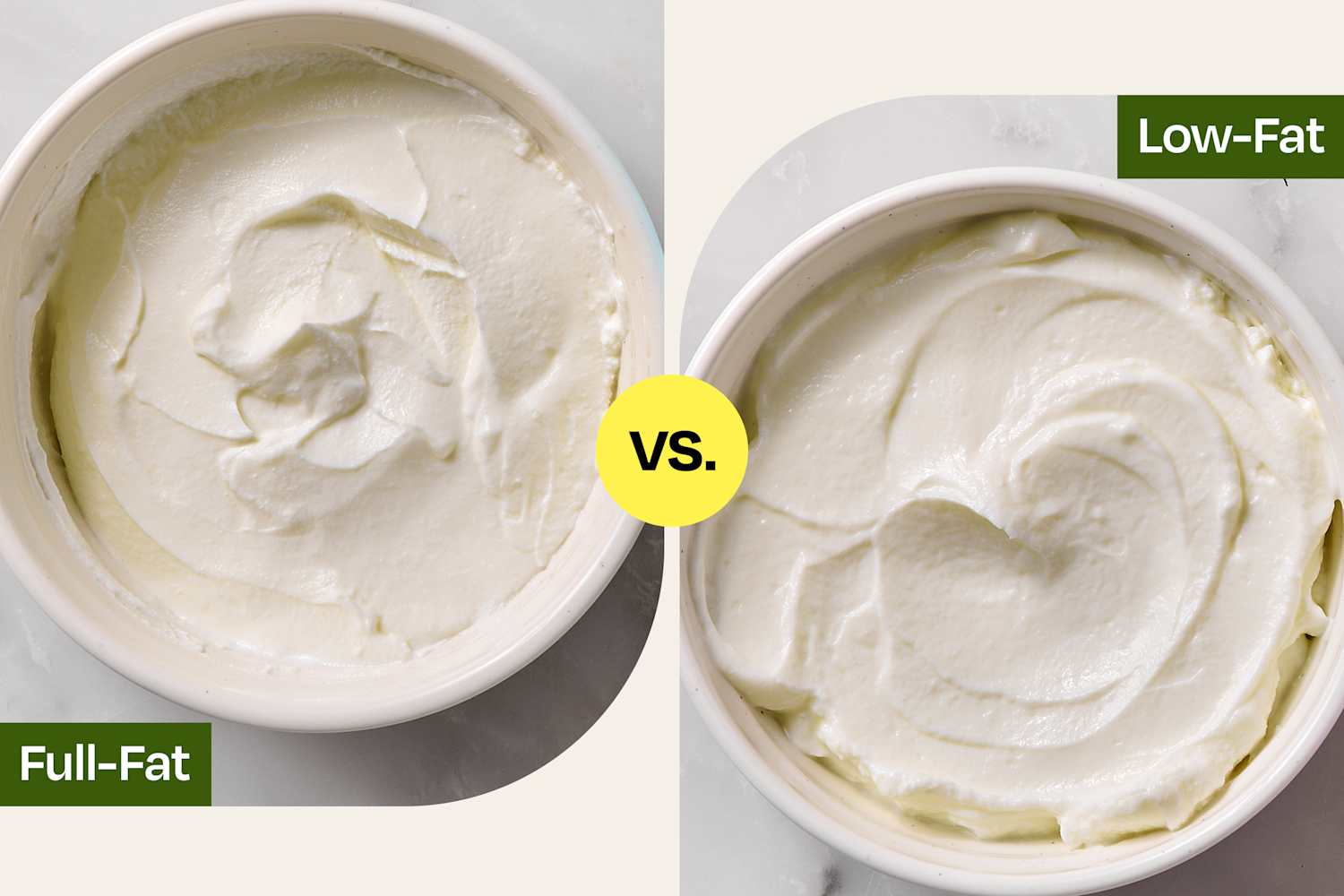
As I type, I currently have no fewer than four different varieties of yogurt in my fridge — and that’s on the low side for me. You see, yogurt is easily my favorite amongst the Swiss-Army-knife ingredients one can keep in their kitchen. All day long you’ll likely find me with my spoon in a container of yogurt, switching between a rich triple-cream or a lighter, tangier Greek-style.
I think there’s no more beautiful collection of words than “10% milkfat” (which is what my favorite yogurt made by Cabot contains), but I know there are plenty of people who’d disagree with me and go the low- or no-fat route. So, in my own Carrie Bradshaw-esque way, I recently glanced down the cavernous yogurt aisle at the grocery store and wondered: Is one better than the other?
In order to suss it out, I asked three registered dietitians. Here’s what they had to say.
Full-Fat vs. Low-Fat Yogurt: Nutrition Facts
Despite their differing fat contents, full-fat and low-fat yogurts have similar nutrition profiles — especially when it comes to sugar and protein.
In fact, the style of yogurt — conventional, Greek, Icelandic skyr — has the most bearing on its overall nutritional content because of the straining process, explains Lindsey Schoenfeld, a chef and registered dietitian. “Greek yogurt, which involves straining some of the liquid, has a thicker, more concentrated texture with a higher protein content.”
Both low- and full-fat yogurts naturally contain comparable levels of lactose (milk sugar), so don’t be too wary of a little sugar when scanning labels. According to Kaitlin Hippley, M.Ed., RDN, LD, CDCES, the flavor of your yogurt (rather than the fat content) will cause the most variation in the sugar content. One of her favorites is Stonyfield organic plain whole-milk yogurt, which contains 8 grams of sugar per serving); its vanilla-flavored counterpart contains 17 grams of sugar.
The caloric content of full-fat yogurt is higher, as fat is naturally calorie-dense, but this isn’t something to shy away from. “Fat slows digestion,” says Schoenfeld. “So full-fat yogurt tends to be more filling, especially when eaten alone or used in recipes.”
“Ultimately, the best yogurt is one that fits your preferences, keeps added sugars low, and leaves you feeling satisfied,” says Hippley.
Full-Fat vs. Low-Fat Yogurt: Ingredient Lists
As you start scanning that yogurt tub’s label (it’s a thrilling read sometimes, not gonna lie), you might be wondering what you should and shouldn’t expect to find on an ingredient list. By and large, all yogurts start with the basics: milk and active cultures. From there the permutations of flavorings and processes can extend ad infinitum, as can the ingredient lists.
This is especially true of low-fat, nonfat, and flavored yogurts, which are typically more processed than whole-milk plain yogurts. “Be aware of ingredients added when natural components are reduced or removed,” advises Schoenfeld, which often includes various artificial thickeners, sweeteners, preservatives, and gums that can lower yogurt’s nutritional value while mimicking the creaminess and sweetness of full-fat varieties.
Full-Fat vs. Low-Fat Yogurt: Prices
They may have similar nutrition profiles, but how do their prices shake out? Is full-fat yogurt going to slim down your wallet? I compared the prices of both low- or no-fat and full-fat yogurts across several popular brands at Walmart — and the answer might surprise you.
I noticed instead that the name brand and style of yogurt (like Greek or Icelandic skyr) have more impact on the price than the fat content.
Full-Fat vs. Low-Fat Yogurt: Versatility
It would seem that I’m not alone in my yogurt-hoarding. “The truth is, I use both options!” says Alexander Leritz, MSc RDN CDN CNSC CPT, Registered Dietitian at JM Nutrition. In fact, all three of the registered dietitians I interviewed admitted to always having tubs of low-fat and full-fat yogurt in their fridges.
“In my profession, we call fats the ‘vehicle of flavor,’” adds Leritz. The fat in full-fat yogurt improves overall satiety, while the creamy richness helps carry both savory and sweet flavors. This is especially true for dishes that call for a bit more heft or texture, like a tzatziki-style dip, savory sauces (think: lemon-dill yogurt sauce for salmon), tenderizing marinades, or where you just need a seamless swap for sour cream on a baked potato or chili.
This is all music to my 10% milkfat-loving ears, as you can imagine. But what if you’re looking for something lighter on the stomach or simply in need of a lower-calorie protein boost to a meal or snack? In that case, Leritz will opt for low-fat yogurt, which is naturally lower in calories due to the lower fat content. “In this scenario, I can use those additional calories to add fresh berries, chia seeds, and maybe a drizzle of honey to make it a tasty treat.” Other favorite uses? Adding moisture and structure to baked goods and a punch of protein to smoothies.
No matter which yogurt you opt for, the dietitians interviewed all stressed that one should, you know, actually enjoy eating said yogurt. “It is important not to be too rigid,” says Leritz. “A yogurt that you enjoy and consistently eat can be more valuable than finding a ‘perfect’ option that will just sit and spoil in the refrigerator.”
Do you prefer low-fat or full-fat yogurt? Tell us about it in the comments below.
