
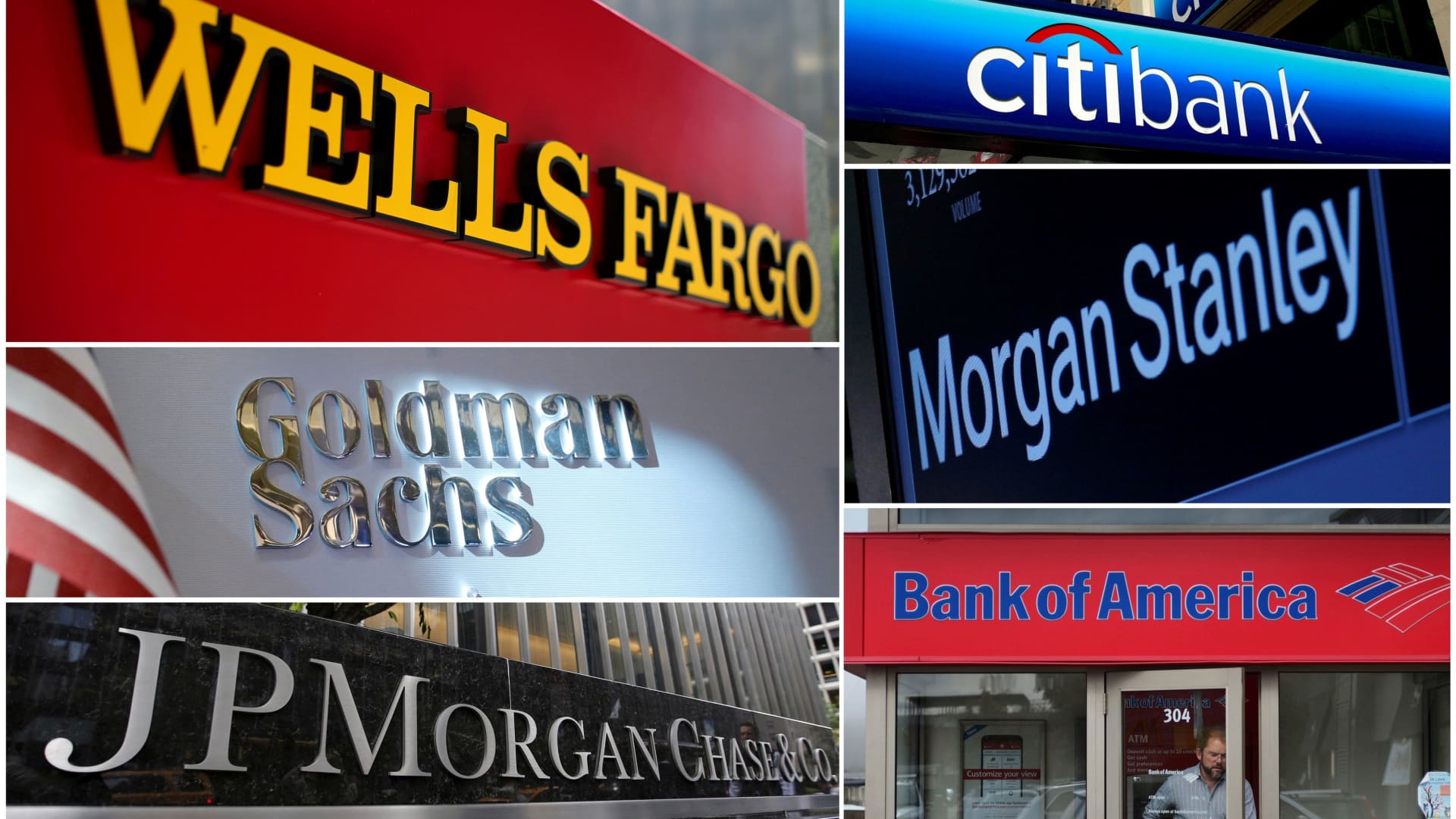
A trifecta of uncertainty — from the Iran war to AI disruption to private credit — is crushing financial stocks this year. While shares of Goldman Sachs and Wells Fargo have been caught up in the downdraft, their businesses should be largely insulated from these headwinds. Nevertheless, Club stocks Goldman Sachs and Wells Fargo have been painted with the same brush as the financial sector at large. In a major reversal from last year’s strength, Goldman has dropped 11% in 2026, while Wells has declined more than 20% year to date. We do not think these stock declines reflect the business fundamentals. It’s a tough — but temporary — pill to swallow, and why we believe these titans of Wall Street should come out just fine on the other side of the current challenges. War with Iran The Iran war has led to volatility in bank stocks due to concerns that soaring oil prices could hurt both consumer and business clients and lead to reduced profits. Spiking oil means higher gas and diesel prices paid at the pump and higher fuel prices required to fly airplanes — all of which can create an inflation shock. Against that backdrop, it might be tough for the Federal Reserve — even under the next likely Fed chief Kevin Warsh — to cut interest rates. That could be bad news for consumers looking for borrowing costs to go down, not to mention being squeezed by paying more to drive and fly places. When consumers are feeling pressured, they tend to rein in spending, which can lead to taking out fewer loans or defaulting on the ones they have. On the business side, those higher fuel costs can pressure margins as energy is a major, unavoidable cost for companies, too. Additionally, when business confidence takes a hit, executives may be more hesitant to make acquisitions and do initial public offerings. That means they don’t need investment banking services as much. They may also look to borrow less. “All of that essentially means growth outlook [for banks] could be slower. We could see more defaults if we get into some version of a stagflationary environment,” Bank of America research analyst Ebrahim Poonawala told CNBC in a recent interview. Stagflation is when there’s muted economic growth, high inflation, and high unemployment. Poonawala, who covers Goldman Sachs, added, “It does increase the probability of downside risks relative to what it would be assumed a week or a month ago.” As a more traditional money center bank, Wells Fargo is more exposed to the lending risks and less to a pullback in dealmaking, while Goldman Sachs is more exposed to fewer mergers and acquisitions. Goldman Sachs’ global banking and markets division, which includes its dealmaking fees, accounted for roughly 77% of overall revenue last quarter . Revenue from investment banking, its largest segment, jumped 25% year over year in the fourth quarter. Weakness in deals is less of a concern for Wells Fargo’s growing investment banking business. IB is housed in the firm’s corporate and investment banking division, which made up 21% of overall revenue last quarter. Wells Fargo has made strides to expand its investment banking presence in order to diversify its bottom line further and not rely so heavily on interest-based income, such as lending, which is at the mercy of the Fed’s rate moves. Sure, those risks are out there. But, as Zev Fima, a portfolio analyst for the Investing Club, said, “We still like the banks because we think this Iran conflict can get sorted quickly enough to avoid a recession.” In an ironic tailwind for the time being, the swings in the stock market are actually a boon for Goldman’s trading desk, which pulls in fees by offering clients complex options and swaps in order to hedge their risks. “This volatility is Goldman’s world,” Jim Cramer said Tuesday. He added, “I really want to buy it here. Right here.” On Thursday, we put together a list of stocks to buy , and Goldman Sachs was on it. Jeff Marks, the Club’s director of portfolio analysis, pointed out that Goldman Sachs was trading at its cheapest price-to-earnings multiple in years — less than 14 times its estimated next 12 months of earnings per share. On Friday, Jim said on CNBC, “I think Wells comes back. They are having a good quarter.” Wells Fargo’s forward P/E is also at a historically low multiple of less than 11 times. AI disruption risks Growing AI adoption has presented another reason for concern among bank investors. Financial stocks sank last month on a viral report by Citrini Research, which outlined a doomsday scenario for AI adoption. The paper said that unemployment rates could surge to 10% by 2030 if machines replace white-collar jobs, resulting in a huge dent to economic growth and much less consumer spending. The AI concerns are overblown, according to Jim , describing the Citrini report as a “dystopian tale,” and “a reach.” He argued that there will be a lot more jobs created than destroyed as AI becomes more integrated into the workforce. We even bought more Wells Fargo stock on Feb. 24 during that AI-induced selloff and shares back to our buy-equivalent 1 rating . That’s because we think AI can actually be a positive for banks and boost earnings. Both Wells Fargo and Goldman have embedded generative AI into their own businesses to make them more efficient. In February, CNBC reported that Goldman has been working with Anthropic to create AI agents to automate a number of internal roles. Before that, Wells Fargo expanded its AI leadership team in January with the appointment of Faraz Shafiq as head of AI products and solutions. Shafiq formerly worked at Amazon Web Services, Verizon, AT & T, and Google. Private credit concerns Wall Street has been on edge about the impact of private credit on banks. Another overreaction. “I know that things are bad with the banks,” Jim said Friday. “It’s bundles of loans, of which not all are bad.” High-profile redemption requests for private credit funds have come in throughout 2026. Blue Owl restricted withdrawals from one of its retail-focused funds last month, sparking fears about a liquidity mismatch. Following the Blue Owl news, asset managers Blackstone and BlackRock both reported elevated redemption requests. Morgan Stanley and a lesser-known firm called Cliffwater also reported pickups in redemption requests. The fast-growing private credit market has taken off over the past several years as investors look for more flexible, higher-yielding lending alternatives to government or corporate bonds. Wall Street’s largest banks are thrown in the mix because private credit funds borrow money from them to increase the size of the loans they offer. However, Goldman Sachs and Wells Fargo are well capitalized, as seen in the results from the Fed’s stress test last summer. Their businesses are also diversified, and private markets are not primary fee drivers for either bank. In fact, Columbia Business School professor Tomasz Piskorski said that banks are “reasonably well protected” from private credit contagion fears. There’s a common misconception, according to Piskorski, that private credit funds are a serious risk because banks are backed on average by 10% equity (capital) and 90% debt (liabilities). In theory, this means that even a 10% decline in the value of a bank’s assets can potentially put the firm at risk of insolvency. The same logic, however, doesn’t apply to private credit funds because these aren’t structured the same way. Instead, Piskorski argued that these vehicles require much more equity or capital. Unlike traditional banks, private credit funds are financed with roughly two-thirds equity and one-third debt on average. “That means that the asset value would have to drop way more than half before the banks … lending to the private credit funds will be impaired,” Piskorski told CNBC in an interview. “In other words, private credit funds have very large capital buffers. So, it’s not the banks – the lenders to private credit funds that are really exposed – it’s the limited partners that provide these private credit funds with equity,” Piskorski added. Private credit, however, was a concern for us when it came to BlackRock — a stock we exited earlier in the month because these worries became too much of a distraction. While not a huge part of its business, we owned the stock on the thesis that private markets would become more mainstream among retail investors. Recent weakness across the industry, however, could create a roadblock to broader adoption. While acknowledging the problems with private credit, Jim said Friday, “We’re going to look back and say this was not 2007.” That year, lending and leverage problems were building ahead of what would spiral into the 2008 financial crisis and the Great Recession. (Jim Cramer’s Charitable Trust is long GS, WFC. See here for a full list of the stocks.) As a subscriber to the CNBC Investing Club with Jim Cramer, you will receive a trade alert before Jim makes a trade. Jim waits 45 minutes after sending a trade alert before buying or selling a stock in his charitable trust’s portfolio. If Jim has talked about a stock on CNBC TV, he waits 72 hours after issuing the trade alert before executing the trade. THE ABOVE INVESTING CLUB INFORMATION IS SUBJECT TO OUR TERMS AND CONDITIONS AND PRIVACY POLICY , TOGETHER WITH OUR DISCLAIMER . NO FIDUCIARY OBLIGATION OR DUTY EXISTS, OR IS CREATED, BY VIRTUE OF YOUR RECEIPT OF ANY INFORMATION PROVIDED IN CONNECTION WITH THE INVESTING CLUB. NO SPECIFIC OUTCOME OR PROFIT IS GUARANTEED.
Trending
- Which WAGs Will Win the Summer of Sport?
- What to Know About The Obama Presidential Center’s Community-Focused Food Programming
- How I Reframed Letting Go So I Could Move on from My Painful Past
- Valentino Resort 2027 Collection | Vogue
- Soldier Delivers United Nations World Food Programme (UNWFP) Supplies to Hard-to-Reach Kyiv Communities
- I Replaced My Chipped Glassware With This Surprisingly Affordable Set
- 10 All-White Outfits to Wear All Summer Long
- The Winners and Best Moments from the 2026 James Beard Awards
