

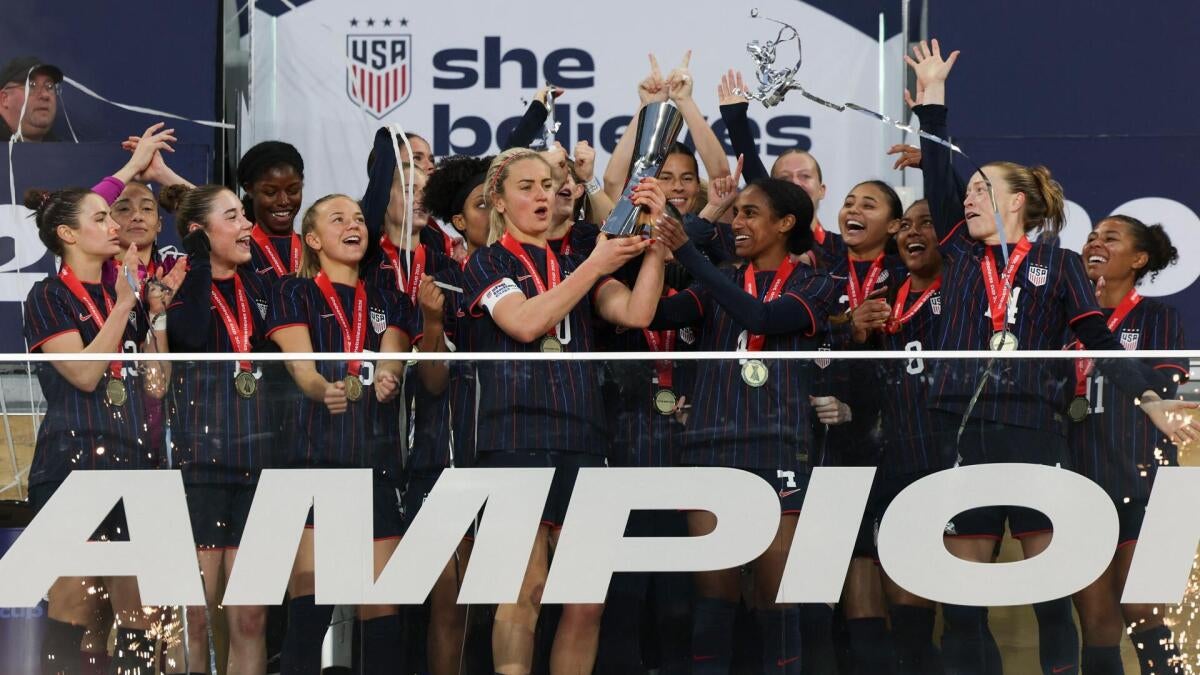

HARRISON, N.J. — Days before the U.S. women’s national team faced off against Colombia in their SheBeleives Cup finale, head coach Emma Hayes already had a theme in place. The three-game stretch, which included wins over Argentina and Canada, was designed to simulate a tournament setting and Hayes has spent much of the last week preaching a mindset of surviving and advancing, a sentiment that kicks into high gear when trophies are on the line.
That framing was inadvertently a perfect lens to view the USWNT’s hard-fought 1-0 win over Colombia on Saturday, Alyssa Thompson’s 82nd-minute goal ensuring they would lift the SheBelieves Cup for the eighth time but proved to be their most demanding test yet. In the first half, the visitors took the game to the four-time world champions – they pestered the U.S. from a physical standpoint, kept the game compact, quickly launched into transition and limited the hosts to zero shots on target for 35 minutes. For a team used to sheer dominance, things were not going according to plan, the 0-0 scoreline at half almost generous.
“I thought we were sluggish, the first half,” Hayes said post-match, offering a harsh but honest assessment of her side’s performance. “I thought everything we did was a step off. I thought we were too deep in midfield. I thought we were slow to press the ball. I thought in general, our play was average.”
In a week defined by the mantra of surviving and advancing, though, Saturday’s match was a perfect microcosm of the concept. The USWNT found a way of turning their historical advantages into tangible differentiators both impressive and unglamorous, adding a new gritty layer to their game. Months away from November’s Concacaf W Championship, the qualification tournament for next year’s Women’s World Cup in Brazil, the timing could not be better.
” I think [today] was not our best day,” midfielder Sam Coffey said, “but we found a way to walk away with a trophy and that’s, I think, what championship teams are made of.”
‘The difference was the bench’
Even as Colombia launched one attack after another in the first half, forcing round after round of last-ditch defending from the USWNT inside the penalty area, it was hard to shake the feeling that the visitors would rue their missed chances if one did not find its way into the back of the net. It was not necessarily down to any fault of their own, but rather the fact that the U.S. had a wide range of difference-makers sitting on their bench. Hayes’ quadruple substitution in the 61st minute – when Jaedyn Shaw, Emma Sears, Olivia Moultrie and Lindsey Heaps came on – revitalized the USWNT’s energy levels, especially at a crucial juncture in the match.
“I felt that gaps were starting to appear between Colombia’s back line and their midfield and sometimes when you want to make things happen, players start to come out of areas to get on the ball lower,” Hayes said. “I said to Jaedyn and Olivia, ‘Stay in them areas. The ball will come. We will find them,’ because we’re getting quicker shifting the ball across space, then inverted Avery [Patterson] and kept Alyssa on the outside and made a tiny change there so that we had a good rest defense structure, knowing that every time we attacked, we stopped the transition second half and it allowed the [No.] 9 and [No.] 10 to be more active and there was much more combination between those players. Granted, when space opens up, it’s easier and then of course, maintain the width on the outside with Emma Sears and also have the width on the outside with Alyssa Thompson, which we didn’t have in the first half because Avery was in that part of the pitch.”
Hayes’ deep bench is the obvious result of her project to expand the player pool, an experimentation period that began as soon as they returned to play after winning Olympic gold in Paris nearly two years ago. The head coach has handed debuts to more than 30 players since taking over in June 2024, a list that includes substitute Sears and Ally Sentnor, who scored the game-winner against Canada three days earlier. Hayes has previously spoken of a lost generation of players that only earned a handful of opportunities to enter the USWNT’s fold between the 2019 and 2023 Women’s World Cup, doing all she can to avoid such an issue heading into the 2027 tournament in Brazil.
“Today, we won the game from the players coming from the bench. The difference was the bench today, even though Alyssa took the goal,” Hayes said. “Really proud of the players and I’m proud of our system. I’m proud of the development from the youth national teams into U-23 transitions and here and of course, that’s us working together to create the right moments for these people is adding a lot of value.”
A newfound emotional control
The USWNT extended their winning streak to nine games with Saturday’s win against Colombia, the professionalism of their performance harkening back to the match that forced them to start their victory streak from scratch – October’s surprise 2-1 defeat to Portugal.
“I don’t think it was our worst day ever but what do you look like when you’re not at your best, just figuring out how to win against different types of opponents,” Coffey said about the USA’s ability to solve problems against Colombia. “They were really disruptive to our flow. They were really physical. I think they were trying to kind of get in our head with that so the more we could stay steady, stay focused on the task at hand – I think I’m really proud of how we navigated that because I think that’s a big step forward for us. I think we’ve succumbed to that in the past, even thinking about our last loss against Portugal and where we didn’t do these things.”
Over the course of the SheBelieves Cup, sticking to the fundamentals has meant maintaining a defensive resolve that will keep them in matches even as scoring goals becomes more challenging in an increasingly competitive women’s soccer landscape. The USWNT may have taken just three shots on target against Colombia but despite weathering the visitors’ storm in the first half, Colombia took just one shot on target over the course of 90 minutes.
“Winning major things, it just requires different games and different approaches in every game and I think we’ve showed all those sides in all three games and I think we’ve shown how to win when we’re not at our best,” Hayes said. “I think we’ve shown the versatility. I think we’ve shown the depth. I think we’ve shown maturity and as a coach, I’m happy about those things and of course, I love shutouts but more importantly, I love that we haven’t [given] up a lot of chances … We’ve done well to minimize games becoming transitional.”
It is a signal of a young USWNT’s emotional control in matches that do not go according to plan, something Hayes had emphasized throughout the SheBelieves Cup.
“I think a big thing we’re working on is our emotional control,” Coffey said. “I think not getting frustrated when we’re not getting calls we should get or [the] referee’s lost control of the game or they’re being really physical and we’re not matching it. Again, there’s always going to be different circumstances that we have to face but just how do we respond to those things, I think, is really important. That response, I would say, is the biggest thing between that game [against Portugal] and this game and the way that we channeled that, maybe, frustration into like, ‘Well, what is in our control and how can we champion that?'”
Question marks at the No. 9 position
Over the last week, the USWNT scored goals from a variety of players and situations – Thompson hit a stunner from distance, Sentnor bagged one off a set piece while Heaps and Shaw each hit strikes from the edge of the penalty area against Argentina. That quartet has solved problems but their work has not done away with an overarching question: Is the USWNT’s player pool deep enough when it comes to center forwards?
Before the SheBelieves Cup began, Hayes identified that area as one that needed further exploration, especially in the absence of Sophia Wilson, Catarina Macario and Michelle Cooper. Sentnor, Shaw and Jameese Joseph got the run out in that position over the last week, and Hayes was pleased with the results but admitted there may still be work to do in that regard.
“For the first two games, I thought [Sentnor] was exceptional, menacing, everywhere,” Hayes said. “She don’t let people breathe. I think in a game today when it got a little bit lower, we needed a different presence. Then you’ve got Jaedyn Shaw you can drop in. I think Jaedyn did really well, held the ball up differently, linked with Olivia. I thought both the [No.] 9 and [No.] 10 did well and then when you need to close a game out and you want a stretch [No.] 9, then we can go to Jameese Joseph. I think we’re in a much better position as a result of all that and I’m pleased knowing it is an area we have to develop and of course, we have to still find those development moments but I think we’re in a better position than we were prior.”
The USWNT looked especially in need of an out-and-out goalscorer on Saturday for a handful of reasons – they were barely taking shots in the first half, while Sentnor is at her best when she is in and around the box so the deeper positioning Colombia forced the hosts into before the halftime break created challenges for her. Shaw, who filled in the role for much of the second half, has that ability in her skillset but the versatile attacker may be better suited for other positions while Joseph had a small cameo at the end.
Even as Hayes begins to answer questions about who her core group might be and how many different ways the USWNT can win games, depth at the No. 9 position – or a lack thereof – is arguably the most glaring uncertainty with World Cup qualification approaching. The return of several missing players could make this all a moot point in the near future but it also offers a stark reminder that even as the USWNT finds their feet without the triple espresso of Wilson, Trinity Rodman and Mallory Swanson, there may still be spots waiting for the trio when they are finally ready to go again as a group.
