

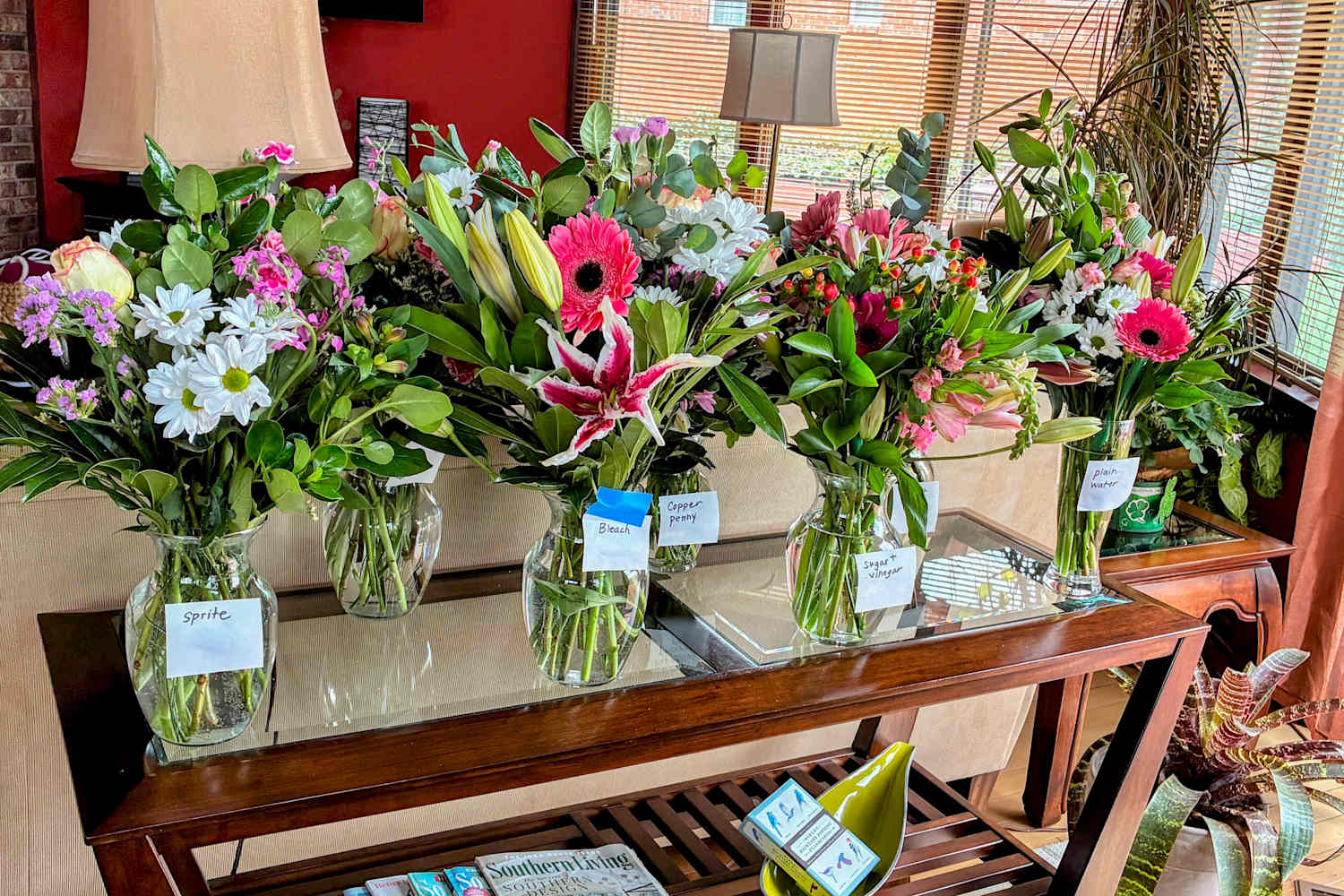
A bouquet of flowers is a little luxury that brings a touch of freshness and cheer into your home. But the problem is, fresh flowers are often expensive and don’t last for very long. I wanted to know how to extend the life of my flower bouquets to get the most out of them, so I set up a side-by-side test to find out which method keeps cut flowers fresh the longest.
To do that, I ordered a bulk set of pink flowers from Costco that included 10 bunches, which was more than enough to run the same experiment across several vases without changing the conditions. The mix included pink lilies, roses, gerbera daisies, carnations, and white daisies with eucalyptus.
Most of the expert botanist and gardener advice online points in the same direction: Some methods focus on feeding the flowers, while others try to slow what’s happening in the water. I wanted to see which methods actually keep cut flowers fresh after a few days, when the water starts to turn and the stems begin to soften.
What Actually Helps Keep Cut Flowers Fresh
Florists describe the same pattern again and again. Once flowers are cut, their lifespan depends on how well the stems can keep taking in clean water. “Any good flower food has something to control bacteria, something to feed the stems, and something to balance pH,” says Laura Walsh, director of marketing and new business development at Smithers-Oasis, an Ohio-based floral care company that develops products used by growers and florists.
Most home methods try to re-create part of that system. Sugar feeds the flowers, vinegar or soda shifts acidity, and bleach or copper is meant to slow bacterial growth. Each one addresses one piece of the problem.
How I Tested the Methods to Keep Cut Flowers Fresh
When the Costco box arrived, I unboxed the stems and sorted them into similar groupings so each arrangement would start from the same place. I removed any damaged stems, then trimmed each stem by about 1 inch at a 45-degree angle. I stripped off any leaves that would sit below the water line.
I placed each arrangement in a clean glass vase and filled it with 4 cups of room-temperature water, enough to cover several inches of the stems without submerging foliage. I kept all of the vases in the same room, away from direct sunlight, heat, and drafts. From there, the only difference between vases was what I added to the water.
Each vase held 4 cups of room-temperature water and one of the following:
I checked each arrangement daily and tracked how the water, stems, and flowers changed over the course of a week. At first, the arrangements looked nearly identical. By the third or fourth day, the differences showed up in the water and the flowers themselves. I focused on three things:
For this test I recorded the time the flowers lasted, which reflects when the arrangement first showed clear signs of decline — like drooping stems, cloudy water, or loss of structure — not when every flower fully wilted. Once the water lost its clarity, the stems softened and the flowers declined soon after in every case. Each method received a score from 1 to 5, with 5 being the most successful, for keeping the cut flowers fresh.
What’s the Best Method for Keeping Cut Flowers Fresh?
The method: Add 4 cups of room temperature tap water.
How it went: This was the control — no additives, just water that was never replaced — so it showed what the flowers would do on their own. By midweek, the water looked dull and slightly cloudy. The stems felt softer when lifted, and the arrangement lost structure sooner than the others. A few blooms started to tilt, and the overall shape looked looser day by day. Without anything to slow bacteria or feed the stems, the flowers relied on what they had left — and it showed.
The method: Add 1/4 teaspoon bleach to 4 cups of water.
How it went: Bleach is often suggested as a way to keep water clean by slowing bacterial growth. Experts often recommend only a small amount of unscented liquid bleach, as bleach can limit bacteria but also damage stems at higher concentrations. The water stayed clearer at first, but the stems softened unevenly, and the arrangement never felt stable. Some flowers held their shape, while others dropped earlier. This method depends on precision. Too little does not do much, and too much can stress the stems — and this lands somewhere in between.
Method 3: Vodka and Sugar
The method: Dissolve 1 teaspoon of white sugar and a few drops of vodka in 4 cups water.
How it went: This method feeds the flowers with sugar and is meant to slow aging with plain vodka. The flowers held for a few days, then followed the same pattern as the control. The water lost clarity, and the stems softened earlier than expected. By midweek, the arrangement started to look tired, even though it looked strong at first. It addressed part of the problem, but not enough to hold over time.
The method: Add ½ cup of Sprite to 3 ½ cups of water.
How it went: Sprite soda is popular because it contains sugar and acid, which can help do some of the same things as flower food. This method started strong. The flowers stayed full and upright early on. For the first few days, it looked like one of the better performers. Then, the water turned cloudy faster than any other vase. Once that happened, the stems softened quickly, and the arrangement began to decline. The shift was noticeable and happened quickly.
The method: Place one penny in 4 cups of water.
How it went: Copper has antibacterial properties, which is why, for years, dropping pennies into flower vases has long been a go-to tip for extending the vase life. But the technique has fallen out of fashion for a couple of reasons. Pennies minted before 1982 contained more copper. After that, pennies were mostly zinc with a thin copper coating, which limited the effect. Now, older copper pennies are harder to come by, which makes this method less practical than it sounds. But in terms of effectiveness, the 1965 penny in the test vase must have worked. The stems stayed firm through most of the week.
Method 6: Sugar and Vinegar
The method: Add 1 teaspoon sugar and 1 teaspoon of white vinegar to 4 cups of water.
How it went: This combination of granulated sugar and distilled white vinegar is often described as a homemade version of flower food, as it feeds the flowers and shifts the acidity of the water. In our test, the flowers kept their structure, and the water stayed clearer than most of the other DIY methods. The stems stayed firm longer, and the arrangement kept its structure through most of the week.
The method: Add 1 packet of flower food into 4 cups of water.
How it went: Flower food is designed to feed the stems, control bacteria, and balance the water. That’s why it comes as the standard packet with most bouquets (mine came with Floralife, so that’s what I used). This was the only method that held steady from start to finish: The water stayed clear, the stems stayed firm, and the flowers kept their shape through the full week. Even at the end, the arrangement still looked like something you would keep on the table.
The Simplest Way to Keep Cut Flowers Fresh
By the end of the week, a pattern emerged: Methods that addressed only one part of the problem worked for a few days. Methods that kept the water stable held longer. The ones that kept the water clear and the stems firm were the ones that lasted.
There were also small differences by flower type. Hardier flowers like carnations held up longer across all methods, while more delicate blooms like lilies showed decline sooner — especially once the water turned cloudy. That made water quality one of the biggest factors in how long the arrangements looked fresh overall. Flower food did both, which is why it stood out.
Walsh says that kind of consistency is what floral preservatives are designed to deliver. “You’re giving the flowers everything they need at once,” she said. “That’s why you see them last longer and hold their shape.”
Walsh says keeping cut flowers fresh comes down to three basics:
How to Make DIY Flower Food
If you don’t have a packet on hand, you can make a simple version of DIY flower food at home. A common mix includes sugar to feed the flowers, an acid like vinegar or lemon juice to balance the water, and a small amount of bleach to slow bacterial growth. The Kitchn recommends a combination of 1 teaspoon of sugar, 1 teaspoon of vinegar, and a few drops of bleach per quart of water. While it might not outperform commercial flower food, it serves the same purpose of feeding the stems, balancing the pH, and controlling bacteria. Those steps make the difference between flowers that fade early and flowers that last through the week.
